
What the operation involves
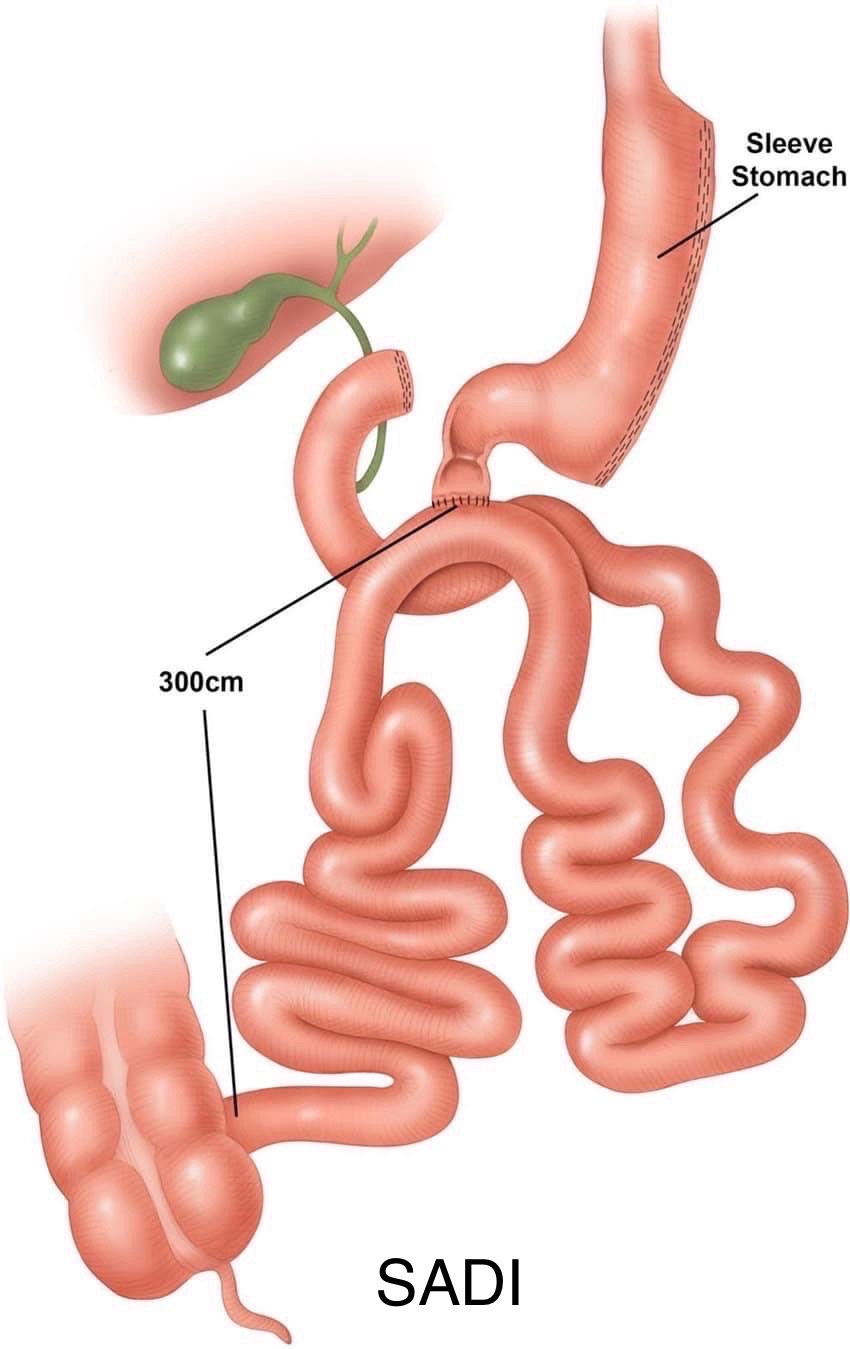
SADI-S has two parts, done in one operation.
First, a sleeve gastrectomy: roughly 80 percent of the stomach is removed, leaving a narrow tube. If you have already had a sleeve, that part is done.
Second, the duodenum is divided just beyond the pylorus — the muscular valve at the stomach outlet — and joined directly to a loop of ileum further down. That leaves a common channel of roughly 250 to 300 centimetres where food and digestive juices finally meet and absorption happens. Everything upstream is bypassed.
Two details matter and set it apart from a gastric bypass. Only one intestinal connection is made, rather than two. And the pylorus is preserved, so the stomach still empties under its own control.
Why those two details matter
- One connection instead of two means fewer places to leak, a shorter operation, and none of the mesenteric defects that make internal hernia a lifelong concern after a Roux-en-Y bypass.
- Keeping the pylorus means food leaves the stomach at a controlled rate. Dumping syndrome is uncommon, and marginal ulcers — the ulcers that form at the join after a bypass, and that put NSAIDs permanently off the table — are far less of an issue.
What results look like
SADI-S produces the greatest weight loss of the operations discussed on this site. Published series report roughly 35 to 40 percent of total body weight lost in the first one to two years — against 25 to 30 percent for a sleeve and 30 to 35 percent for a bypass. For someone starting at 350 pounds, that is a difference of perhaps 20 to 35 pounds compared with the other operations.
What is more unusual is how well it holds. Long-term series report around 38 percent of total body weight still lost at five years and about 34 percent at ten — a shallower drift back than most operations show over the same period.
Its effect on type 2 diabetes is at least as striking. Reported remission rates run from around 60 to 86 percent depending on the series and how remission is defined, placing it alongside or ahead of the gastric bypass, which had long been the benchmark.
That power is the whole point, and the whole problem. The same rerouting that produces the weight loss also means a large part of your small intestine no longer absorbs what passes through it. You cannot have one without the other.
What it asks of you
This is the operation with the most demanding aftercare, and nobody should have it without understanding that plainly.
- Fat-soluble vitamin deficiency is the central long-term risk. Vitamins A, D, E and K are absorbed in the stretch of intestine this operation bypasses. Supplementation is lifelong, in specific forms, and it is not optional.
- Protein malnutrition is possible in a way it generally is not after a sleeve or a bypass. This is why the common channel length matters: the original 200-centimetre version caused unacceptable rates of low albumin, and the standard was lengthened to about 250 centimetres in response.
- Bowel habit changes. Loose, frequent, fatty and frankly malodorous stools are common, particularly early and particularly after fatty meals. Most patients adapt. Some do not.
- Regular blood tests, indefinitely. Deficiency after this operation is often silent until it is advanced. Annual labs are the minimum, and patients who disappear from follow-up are the ones who get into trouble.
- Reflux may not improve. The sleeve component can cause or worsen heartburn, so significant existing GERD generally points toward a bypass instead.
- Less long-term data. The technique was first described in 2007. We have good ten-year data on the bypass and sleeve; the evidence base here is younger, though it is now substantial enough that ASMBS endorsed SADI-S as an appropriate operation in 2020, having first reviewed it in 2016.
Why I offer it
SADI-S is a newer operation than the sleeve or the bypass, and it asks more of a patient than either. It is also, on the published evidence, the most effective of them — the greatest weight loss, the strongest results for type 2 diabetes, and a durability at five and ten years that the others struggle to match.
My expectation is that it will prove at least the equal of the gastric bypass as longer-term data matures. That is my reading of the evidence rather than something the ten-year figures can yet confirm, and I will say as much when we discuss it.
Insurance is the practical obstacle
Coverage for SADI-S lags behind the sleeve and the bypass. Some plans still treat it as investigational, notwithstanding that ASMBS endorsed it as an appropriate operation in 2020. Others cover it only after a documented failure of a previous procedure.
This is worth checking at the very first phone call rather than at the end of a workup. Call the office and we will find out where your particular plan stands before you invest months in the process.
Who it tends to suit
- Patients at very high BMI, where a sleeve or bypass alone is unlikely to be enough
- Patients with difficult type 2 diabetes, particularly long-standing or insulin-dependent
- Patients who have had a sleeve and lost too little, where SADI-S completes the operation as a second stage rather than starting again
- Patients who genuinely will attend follow-up and take supplements for the rest of their lives
When it is the wrong choice
- Significant reflux or a large hiatal hernia — a bypass is usually better
- Inflammatory bowel disease, or previous extensive small bowel surgery
- Any real doubt about long-term follow-up and supplementation
- A patient whose goals would be met by a simpler operation, or by medication
A note on names. You will see this operation called SADI-S, single anastomosis duodenal switch, loop duodenal switch, or SIPS. They describe the same thing. It is a cousin of the older biliopancreatic diversion with duodenal switch, which uses two intestinal connections instead of one and is a bigger operation.
Is this the right operation for you?
It is the most powerful option and the most demanding one, which makes it exactly the kind of decision that deserves a full hour rather than a leaflet.