
An appealing idea
For a while, the adjustable band was the most appealing idea in bariatric surgery. Nothing is cut, stapled, or removed. A silicone band goes around the top of the stomach, creating a small pouch above it. Tubing runs to a port under the skin, and saline is added or withdrawn to tighten or loosen it. Low operative risk, quick recovery, fully reversible.
It is worth being straightforward about what happened next.
What the data showed
In 2011, the adjustable band accounted for roughly 35 percent of all bariatric procedures performed in the United States — about 56,000 operations. By 2019 it was under 1 percent, and by 2023 it was 773 operations nationwide. That is not a fashion cycle. That is what a field looks like when long-term data arrives and points clearly in one direction.
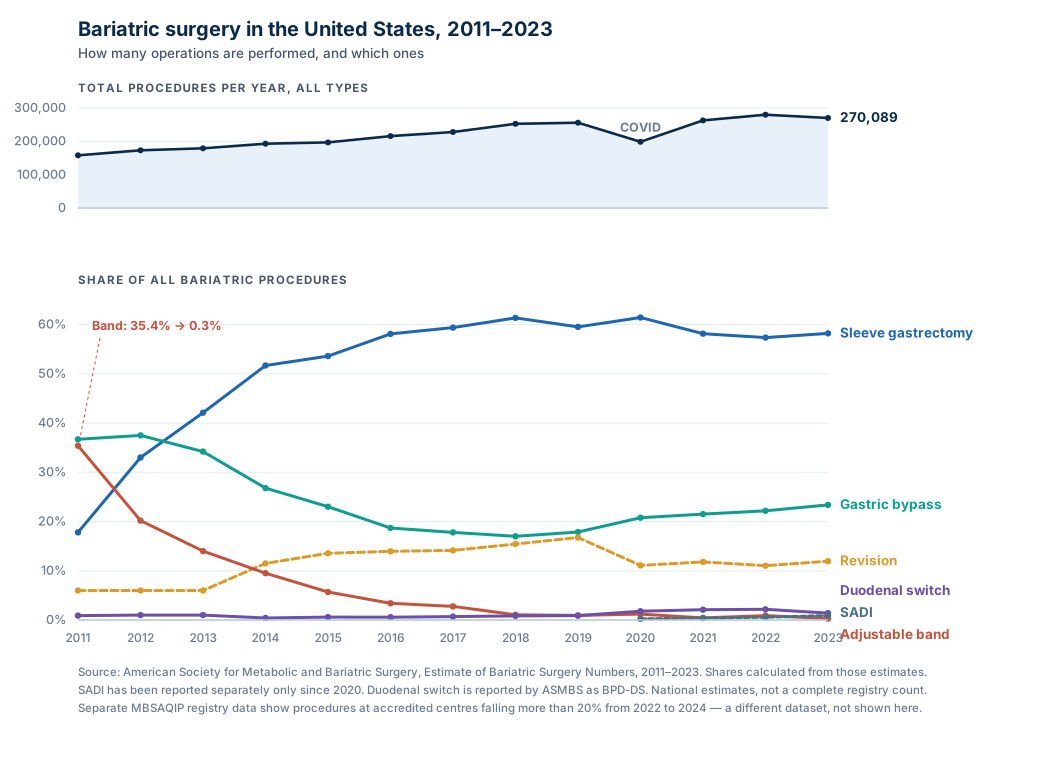
See the underlying figures
| Procedure | 2011 | 2012 | 2013 | 2014 | 2015 | 2016 | 2017 | 2018 | 2019 | 2020 | 2021 | 2022 | 2023 |
|---|---|---|---|---|---|---|---|---|---|---|---|---|---|
| Sleeve gastrectomy | 28,124 17.8% | 57,090 33.0% | 75,359 42.1% | 99,781 51.7% | 105,448 53.6% | 125,318 58.1% | 135,401 59.4% | 154,976 61.4% | 152,413 59.5% | 122,056 61.4% | 152,866 58.1% | 160,609 57.4% | 157,254 58.2% |
| Gastric bypass | 57,986 36.7% | 64,875 37.5% | 61,218 34.2% | 51,724 26.8% | 45,276 23.0% | 40,316 18.7% | 40,574 17.8% | 42,945 17.0% | 45,744 17.9% | 41,280 20.8% | 56,527 21.5% | 62,097 22.2% | 63,132 23.4% |
| Revision | 9,480 6.0% | 10,380 6.0% | 10,740 6.0% | 22,195 11.5% | 26,656 13.6% | 30,077 13.9% | 32,238 14.1% | 38,971 15.4% | 42,881 16.8% | 22,022 11.1% | 31,021 11.8% | 30,894 11.0% | 32,267 11.9% |
| Adjustable band | 55,932 35.4% | 34,946 20.2% | 25,060 14.0% | 18,335 9.5% | 11,172 5.7% | 7,310 3.4% | 6,318 2.8% | 2,660 1.1% | 2,375 0.9% | 2,393 1.2% | 1,121 0.4% | 2,500 0.9% | 773 0.3% |
| Duodenal switch | 1,422 0.9% | 1,730 1.0% | 1,790 1.0% | 772 0.4% | 1,176 0.6% | 1,236 0.6% | 1,588 0.7% | 2,123 0.8% | 2,272 0.9% | 3,555 1.8% | 5,525 2.1% | 6,096 2.2% | 3,775 1.4% |
| SADI | — | — | — | — | — | — | — | — | — | 488 0.2% | 1,025 0.4% | 1,567 0.6% | 2,387 0.9% |
| All procedures | 158,000 | 173,000 | 179,000 | 193,000 | 196,700 | 215,666 | 228,005 | 252,564 | 256,000 | 198,651 | 262,893 | 279,967 | 270,089 |
Two findings drove it. The weight loss was smaller than hoped and it did not hold. And the reoperation rate was high — across published long-term series, a substantial share of banded patients required removal, replacement, or conversion within ten years, in some series approaching or exceeding half. Meanwhile the sleeve gastrectomy arrived: a straightforward operation with better results and no implanted device to maintain.
Why it underperformed is not mysterious. The band restricts volume and does nothing else. It does not touch the hunger signaling or the gut hormone changes that make the sleeve and the bypass work. A patient with an intact appetite and a band can still take in plenty of calories — slowly, in small amounts, or in liquid and soft forms that pass straight through. The operation asked patients to supply, by willpower, precisely what the other operations supply biologically.
What is happening right now
The chart above stops in 2023, because that is the last year for which ASMBS publishes a national estimate. Newer figures come from a different source and point somewhere uncomfortable.
Research presented at the ASMBS annual scientific meeting in May 2026, drawn from the MBSAQIP registry of accredited centers, found that bariatric operations in the United States fell below 200,000 in 2024 — the first time since 2020, and a decline of more than 20 percent from the year before. Over the same broad period, prescriptions of GLP-1 medications for obesity rose sharply.
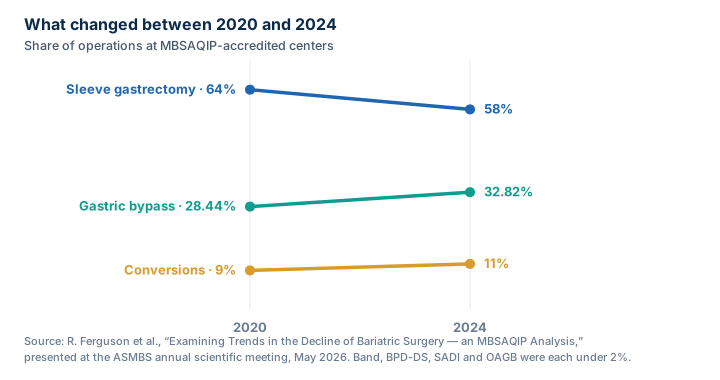
The mix shifted as well as the volume. Sleeve gastrectomy, long dominant, fell from 64 percent of operations to 58 percent. Gastric bypass rose to 32.82 percent, its highest share in five years. Conversions and revisions went from about 9 percent to 11 percent. Everything else — band, duodenal switch, SADI and OAGB — came in under 2 percent each.
Read that alongside the band story. Twice now the field has moved sharply: away from the band in the 2010s, and toward medication in the 2020s. Both shifts were real responses to real evidence. Neither means the thing being left behind was worthless, and neither means the new thing suits everybody. What it does mean is that you want someone who will discuss both honestly rather than only the treatment he happens to sell. This practice offers medication and counseling as well as surgery, precisely so that conversation can be had.
Realistic results, stated plainly
- Weight loss was modest. Perhaps 15 to 20 percent of total body weight in patients who did well, against 25 to 30 percent for a sleeve and 30 to 35 percent for a bypass. Long-term averages come in lower still, because bands get loosened, fail, or are removed.
- Results depended heavily on follow-up. The band needs adjusting. Patients who came in faithfully for fills did meaningfully better than those who did not — a real burden to carry over years.
- The metabolic benefit was limited. Diabetes improvement tracked weight loss and nothing more.
- Problems accumulated with time rather than at the start. The band was the safest of these operations on day one and the least durable at year ten.
See the band compared against the sleeve, bypass, and revision surgery →
If you already have a band
Having a band is not an emergency, and it does not automatically mean it has to come out. Some patients have had one for fifteen years, are happy with their weight, and have no symptoms. If that is you, keep up your follow-up and leave well enough alone.
Come in and be evaluated if any of these apply
- Reflux, regurgitation, a night-time cough, or the feeling that food sticks
- Difficulty swallowing, or vomiting after meals
- Weight regain, or weight loss that never came
- Pain, swelling, or redness around the port
- A band that has not been checked in years
What evaluation involves
Usually imaging and often endoscopy, to see where the band sits and whether it has slipped, eroded, or caused the esophagus to dilate. Records from your original surgery help if you can get them, but their absence is not an obstacle.
The options from there
- Removal alone, when the band is the problem and you do not want another operation
- Removal with conversion to a sleeve or a gastric bypass, in one stage or two
- Medication instead — for weight regain without a mechanical problem, medical weight loss is often the right thing to try before a second operation
- Leaving it alone and adjusting the plan around it
Removing a band is not a failure, and it is not your fault. You chose a reasonable operation based on the evidence available at the time, and the evidence changed. That is how medicine is supposed to work.
Common questions
My band was placed by another surgeon. Can you still take it out?
Yes, and this is the usual situation. Many band patients had the original operation at a program that has since closed or with a surgeon who has retired. You do not need a referral from them and you do not need your old records in hand.
Can the band be removed and a sleeve or bypass done at the same time?
Sometimes. Whether it is done in one operation or two depends on what the tissue looks like where the band has been sitting — scarring, inflammation, or erosion can make a staged approach the safer choice. That decision is made from imaging and endoscopy beforehand, and confirmed in the operating room.
Will I regain weight after the band comes out?
Often, if nothing replaces it. That is precisely why the conversation is about what comes next rather than just about removal — whether that is a conversion operation, weight loss medication, or a deliberate decision to manage without either.
Does insurance cover band removal?
Frequently yes when there is a documented complication such as slippage, erosion, or intolerable reflux. Coverage for removal purely because of weight regain, or for conversion to another operation, varies considerably and often requires more documentation. We will tell you early what your plan appears to allow. One requirement to check first →
Is anyone still having a band placed?
Very few, and this practice does not recommend it as a first operation. The occasional patient has a specific reason to want a device that can be removed with the stomach left intact, and that conversation can be had honestly. For nearly everyone, a sleeve or a bypass is the better answer — and for those who want no operation at all, medical weight loss now covers much of the ground the band was reaching for.
Have a band and not sure where you stand?
Come get it looked at. An hour with a surgeon who has placed and removed more than 1,500 of them beats guessing.